About
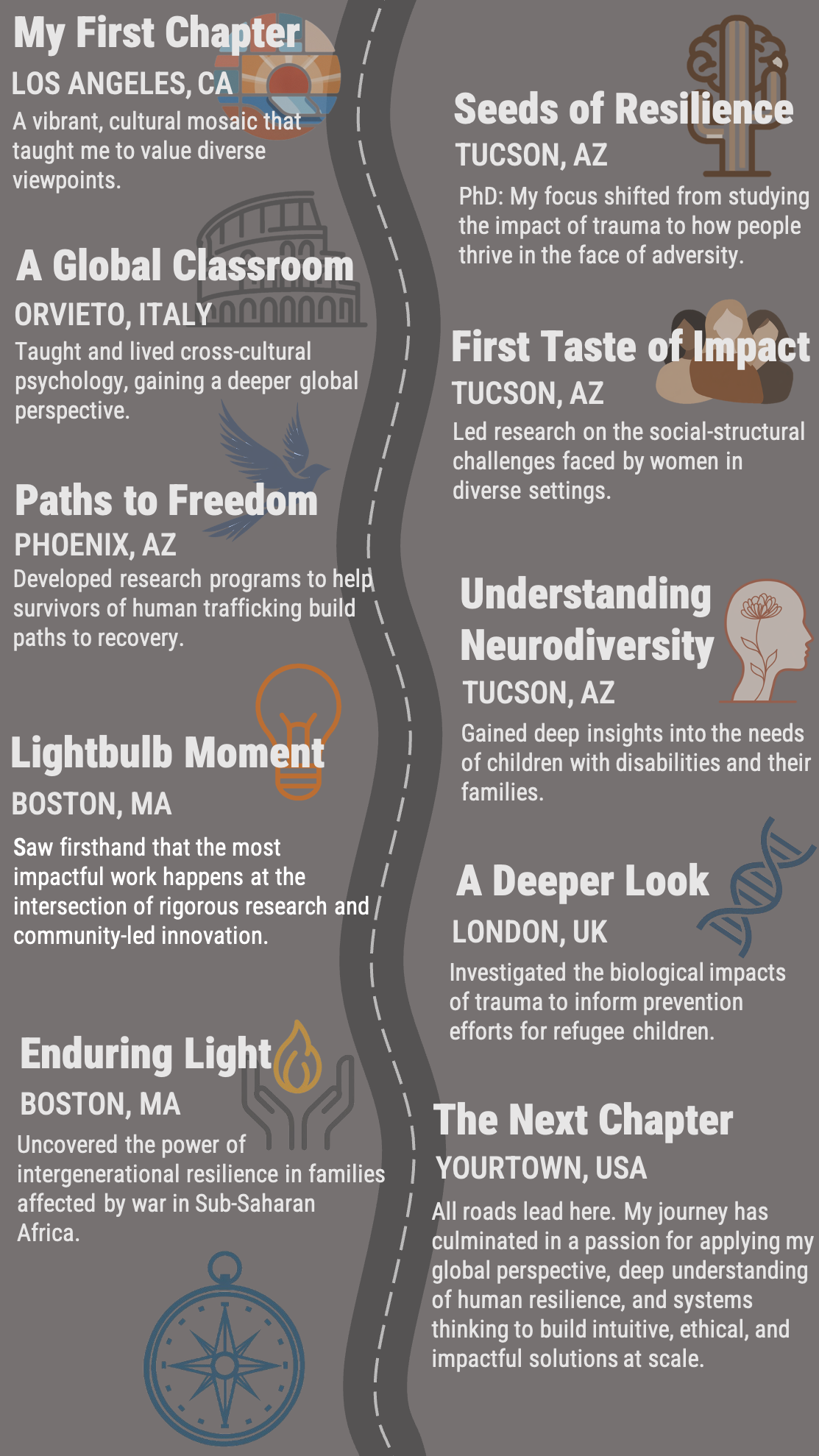
For as long as I can remember, I’ve been driven by a fundamental curiosity about people: what motivates us, how we navigate complex challenges, and what it takes to build systems that genuinely support human well-being. This curiosity led me to pursue a Ph.D. in Psychology and a career leading research in some of the most challenging environments around the world.
I’ve had the privilege of working with communities in places like Mexico, Rapanui, Rwanda, and Sierra Leone, as well as with survivors of human trafficking and refugees in the U.S. and Lebanon. Early on, my work focused on the impact of exploitation, conflict, displacement, and poverty on families and children. Over time, I grew deeply interested in understanding the factors that helped people heal from or even thrive in spite of these experiences. From cellular processes to healthcare systems, I have designed and led investigations to figure out what works, for whom, and why. This wasn't just academic; it was about generating real-world evidence to build better, more effective supports for people in need.
Along the way, I’ve helped develop and test tools that make it easier for community health workers, government, and families to deliver higher quality care. Those experiences reinforced something I see again and again: the most effective solutions emerge when rigorous research is paired with co-creation, and when communities are valued as partners and experts in their own lives. Co-designing with communities isn't just a method; it's the essential bridge between evidence and real-world impact.
That realization is what guides my work today.
Today, my work sits at the intersection of global health, social innovation, and implementation science. I’m especially interested in approaches that address the root causes of risk, reduce vulnerabilities, and strengthen the systems that support development, mental health, and well-being over time. I love diving into complex data, both qualitative and quantitative, to find a story and then translating that story into clear choices, trade-offs, and strategies that people can act on with confidence.
Whether the goal is to understand the needs of a family in a low-resource setting, adapt an evidence-based intervention for a new community, or uncover the patterns hidden in a large dataset, the fundamental challenge is the same: to listen, to learn, and to use evidence to make things better for the people at the center.
When I'm not deep in research, you can find me exploring new worlds and engaging in a bit of collaborative storytelling through tabletop role-playing games.
I’m always excited to connect with people who are passionate about solving meaningful problems. If that’s you, feel free to reach out.